

Replit
by Community
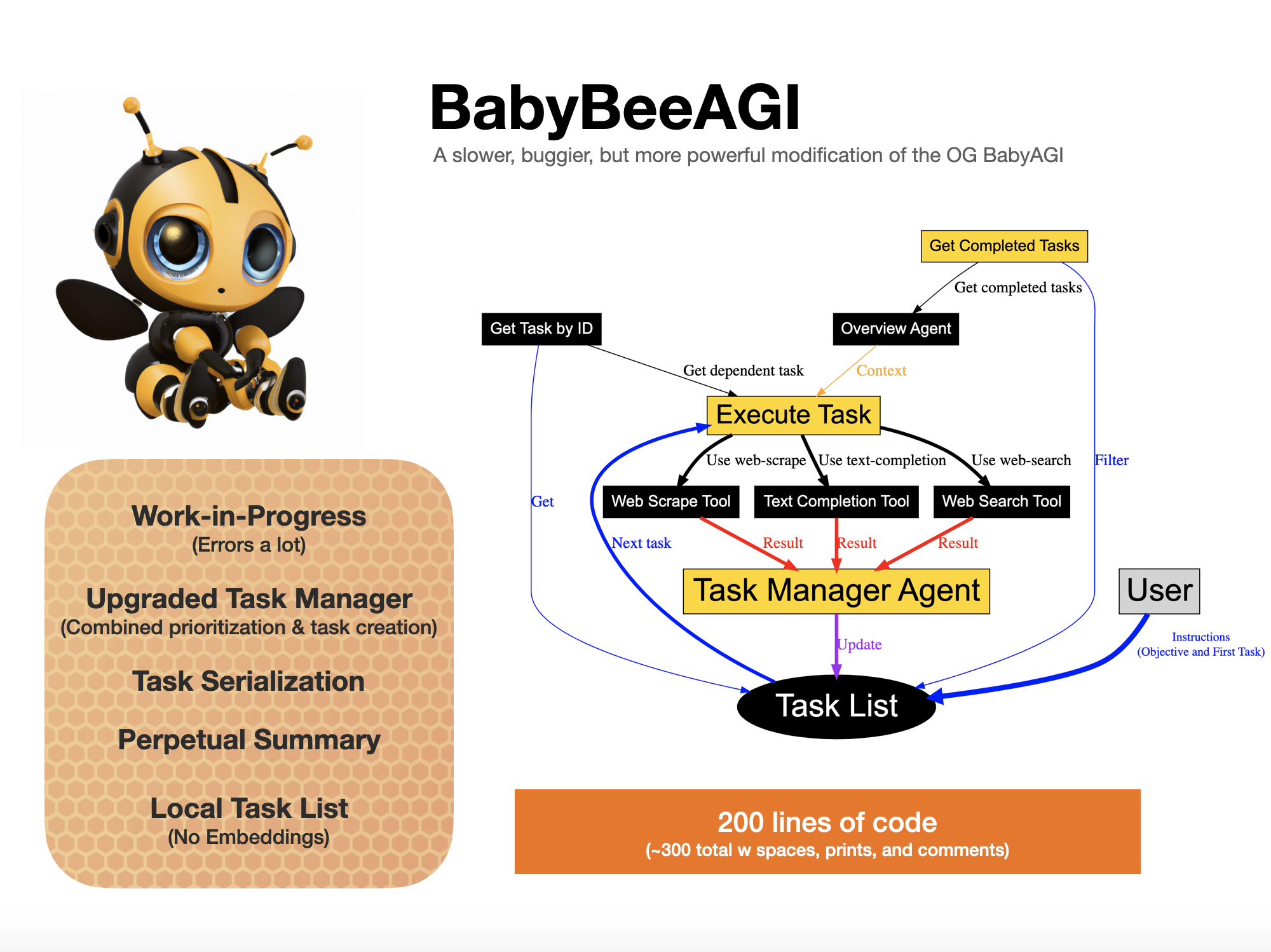
BabyBeeAGI is a mod of OG BabyAGI - at ~300 lines of code (200 lines without comments, prints, and empty lines). This was built as a continued iteration on the original BabyAGI c
Agents
Replit
Added 1 June 2026
Overview
BabyBeeAGI is a lightweight modification of BabyAGI with about 300 lines of code. It automates task generation and execution using GPT-4, but it is slower and buggier than the original. Builders can fork the Replit project, add an API key, and set an objective to experiment with autonomous agent workflows.
Best for
Best for
Developers exploring lightweight autonomous agent architectures
Use cases
- Forking and modifying a minimal autonomous agent codebase
- Prototyping simple task generation and execution loops
- Learning how BabyAGI works without a large codebase
Notes
BabyBeeAGI is a lightweight modification of BabyAGI with about 300 lines of code. It automates task generation and execution using GPT-4, but it is slower and buggier than the original. Builders can fork the Replit project, add an API key, and set an objective to experiment with autonomous agent workflows.
Use cases
- Forking and modifying a minimal autonomous agent codebase
- Prototyping simple task generation and execution loops
- Learning how BabyAGI works without a large codebase
Pros
- Very small codebase (~300 lines) making it easy to understand and modify
- Ready to run on Replit with minimal setup
- Transparent implementation ideal for educational experimentation
Cons
- Requires GPT-4, which increases cost and latency
- Significantly slower than the original BabyAGI
- Buggy and not reliable for real-world tasks
Indexed from awesome-ai-agents and enriched against its public facts.
Pros
- Very small codebase (~300 lines) making it easy to understand and modify
- Ready to run on Replit with minimal setup
- Transparent implementation ideal for educational experimentation
Cons
- Requires GPT-4, which increases cost and latency
- Significantly slower than the original BabyAGI
- Buggy and not reliable for real-world tasks
Pairs with
Other entries in the index that connect to this one. Click through to see the chain.

Get the free Developer’s Field Guide
A 27-page field guide to the AI coding workflow with Claude. Claude Code, MCP servers, the prompt patterns that work, and what to delegate. Free.
Enter your work email. We send it straight over, plus a few short notes worth knowing. Unsubscribe any time.