

systemprompt.io
by Community
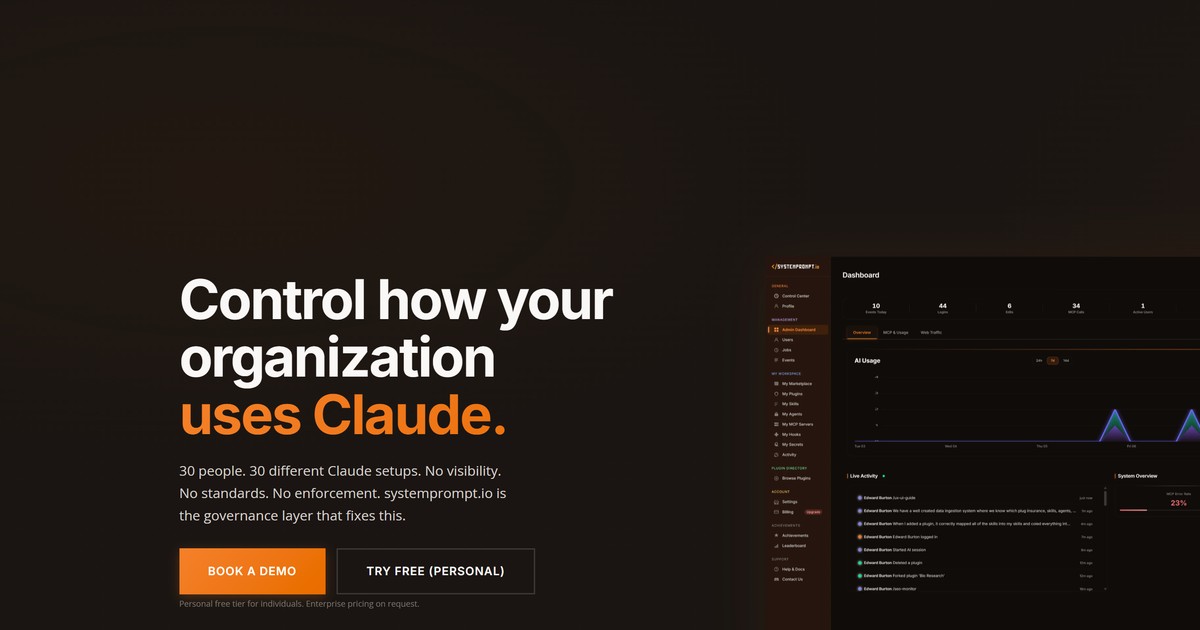
The governance layer for AI agents. A single compiled Rust binary that authenticates, authorises, rate-limits, logs, and costs every AI interaction. Self-hosted, air-gap capable,
OSS
systemprompt.io
Added 1 June 2026
Overview
systemprompt.io is a self-hosted governance layer for AI agents. It runs as a single compiled Rust binary that authenticates, authorizes, rate-limits, logs, and tracks costs for every AI interaction. It is provider-agnostic and can operate in air-gapped environments.
Best for
Best for
Teams that need a lightweight, self-hosted observability and access control layer for AI agents in secure or air-gapped environments.
Use cases
- Enforce access control and rate limits on internal AI agent APIs
- Audit and log all AI interactions for compliance or debugging
- Track per-user or per-agent AI usage costs across multiple providers
Notes
systemprompt.io is a self-hosted governance layer for AI agents. It runs as a single compiled Rust binary that authenticates, authorizes, rate-limits, logs, and tracks costs for every AI interaction. It is provider-agnostic and can operate in air-gapped environments.
Use cases
- Enforce access control and rate limits on internal AI agent APIs
- Audit and log all AI interactions for compliance or debugging
- Track per-user or per-agent AI usage costs across multiple providers
Pros
- Single binary deployment with no external dependencies
- Air-gap capable for sensitive or offline environments
- Provider-agnostic so it works with any AI service
Cons
- Self-hosted requires your own infrastructure and maintenance
- Community project may have limited support or documentation
- Rust binary may not integrate easily with non-Rust toolchains
Indexed from awesome-llmops and enriched against its public facts.
Pros
- Single binary deployment with no external dependencies
- Air-gap capable for sensitive or offline environments
- Provider-agnostic so it works with any AI service
Cons
- Self-hosted requires your own infrastructure and maintenance
- Community project may have limited support or documentation
- Rust binary may not integrate easily with non-Rust toolchains
Pairs with
Other entries in the index that connect to this one. Click through to see the chain.

LiteLLM 🚅
Community
Python SDK, Proxy Server (AI Gateway) to call 100+ LLM APIs in OpenAI (or native) format, with cost tracking, guardrails, loadbalancing and logging. [Bedrock, Azure, OpenAI, Vertex
AutoGPT
Community
AutoGPT is the vision of accessible AI for everyone, to use and to build on. Our mission is to provide the tools, so that you can focus on what matters.
OpenHands
All Hands AI
Open-source autonomous coding agent platform. Spins up a sandboxed dev environment, ships PRs end to end.
Get the free Developer’s Field Guide
A 27-page field guide to the AI coding workflow with Claude. Claude Code, MCP servers, the prompt patterns that work, and what to delegate. Free.
Enter your work email. We send it straight over, plus a few short notes worth knowing. Unsubscribe any time.