01
🧱
The problem
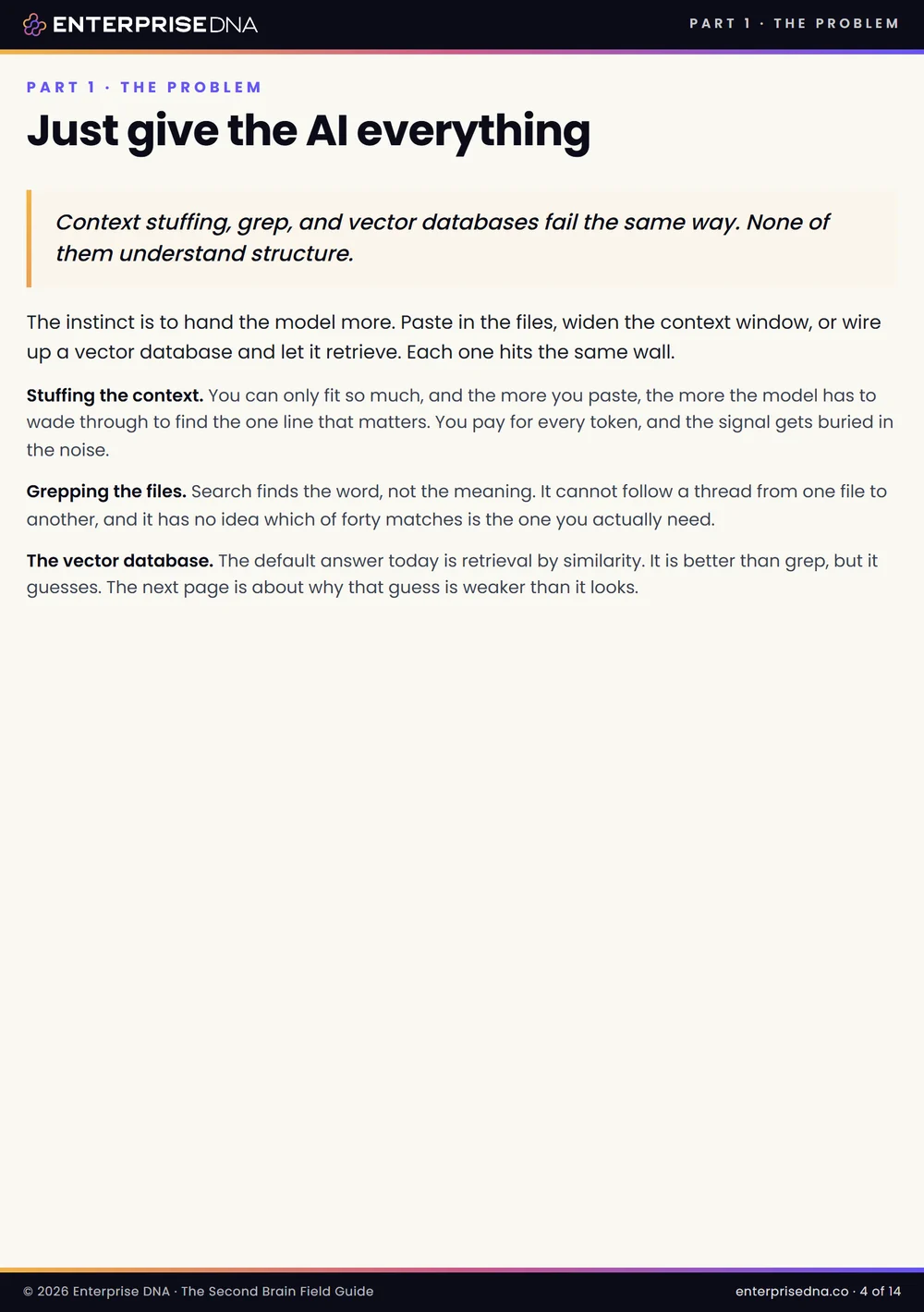
Context stuffing, grep, and vector databases fail the same way. None of them understand structure, and the vector-database default guesses more than it looks.

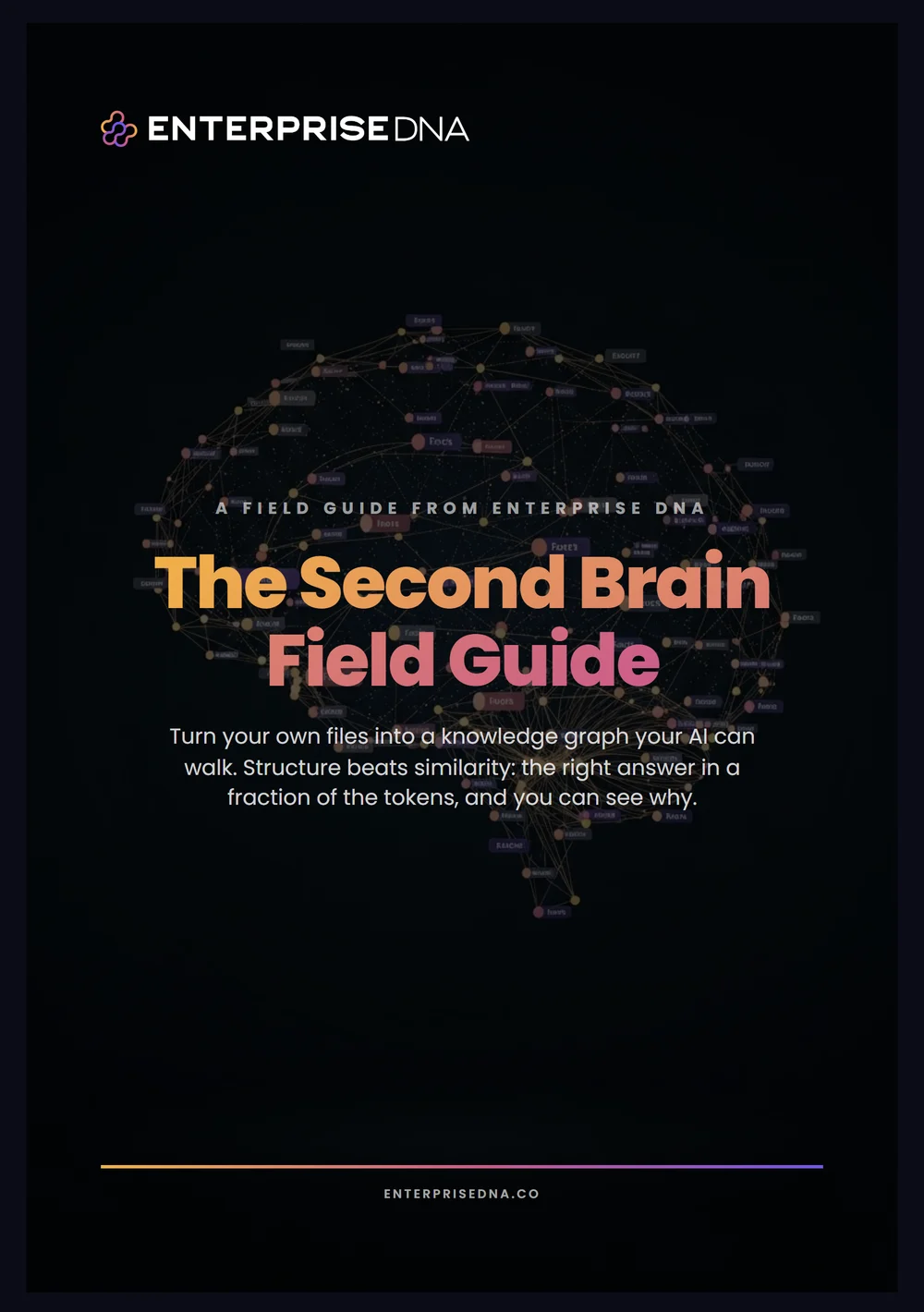
A free 14-page field guide to building a second brain for your AI. Not a vector database you hope retrieves the right chunk, a structural graph the model walks to the answer, in a fraction of the tokens.
Free Resource
14 pages on building a knowledge graph your AI can walk. Free.
Check your downloads folder. If it did not open automatically, use the button below.
Download the Guide
220K+
Professionals trained globally
across 50+ countries
NZ-founded
ANZ-focused content
built for the local market
14 pp
Practical field guide
a graph you can build this week
What's inside
Written for anyone whose AI forgets, retrieves the wrong thing, or burns tokens re-reading everything. What works today, and why structure beats similarity.
01
🧱
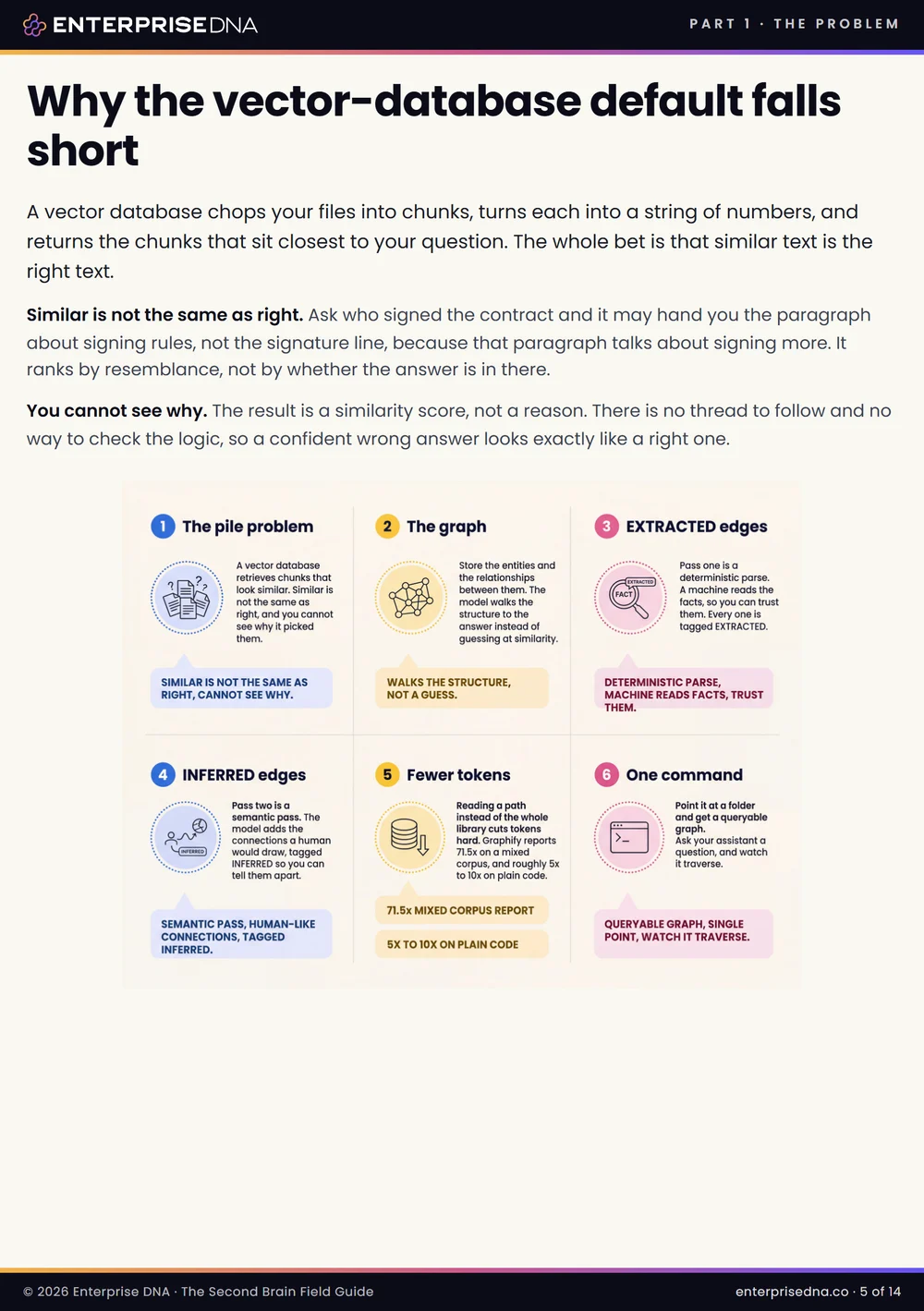
Context stuffing, grep, and vector databases fail the same way. None of them understand structure, and the vector-database default guesses more than it looks.
02
🕸
A knowledge graph, not a pile. Store the entities and the relationships between them, the way Karpathy framed an LLM wiki, so the model walks the structure instead of guessing.
03
⚙
The two passes: a deterministic parse for facts you can trust, then a semantic pass for the connections a human would draw. Plus the token math that makes it worth it.
04
🚀
The one-command flow. Point it at a folder, get a queryable graph, and ask your assistant in plain language. Then keep it fresh as your files change.
05
✅
We run the code version of this ourselves. CodeGraph turns our own codebase into a graph our agents read instead of grepping, across more than 25 repositories.
Six parts in the PDF: the problem, the idea, the method, do it yourself, the proof, and where this goes.
Peek inside
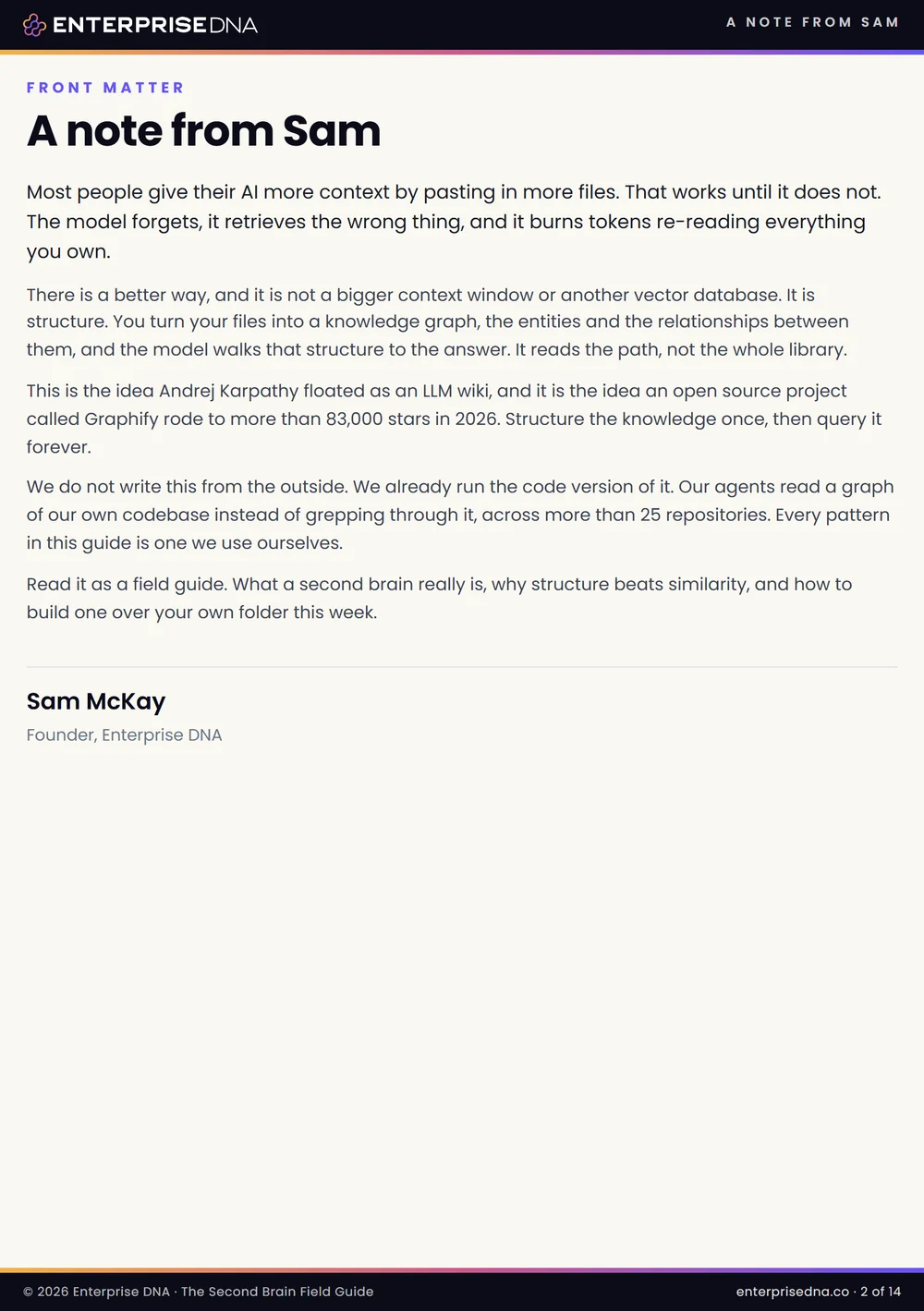
A note from Sam, the full contents, and the first part. The same pages you get in the PDF, shown here in full.
"Most people give their AI more context by pasting in more files. The better move is structure. Turn your files into a graph the model can walk, and it reads the path, not the whole library. We run the code version of it ourselves."
SMSam McKay
Founder, Enterprise DNA
5 of 14 pages
Why structure beats similarity, the two-pass method, the token math, the one-command flow to build one over your own folder, and the proof we run it ourselves. 9 more pages.
Read the full 14-page guideFree. No credit card. Sent straight to your inbox.
"Enterprise DNA trained 220,000+ professionals in data and analytics. If that is your background, a second brain is closer than you think, because you already know what a clean, connected answer looks like. This guide shows you how to build one over your own files."
Sam McKay
Founder, Enterprise DNA · NZ-based
Free download
14 pages. No credit card. No paywall. Just how to turn your files into a knowledge graph your AI can walk, and why structure beats similarity.
Check your downloads folder. If it did not open automatically, use the button below.
Download the GuideWant structured training instead? Browse the full course library
Explore more